
Campaspe Shire is on the lands of the Yorta Yorta, Taungurung and Dja Dja Wurrung peoples. Located in the Loddon Mallee region of Victoria, the Shire is one of the State’s 79 local government areas. It has a population of nearly 40,000 people and covers approximately 4,500 square kilometres. Echuca, the Shire’s largest town, is a significant tourist destination located about 220kms from Naarm/Melbourne. The area is crossed by the Campaspe, Murray and Goulburn rivers – a fact reflected in both its natural beauty and history of flooding.
More detailed information about Campaspe Shire and its people is available from:
Jesuit Social Services is a social change organisation working to build a just society where all people can live to their full potential. The Centre for Just Places was established by Jesuit Social Services in early 2021 with support from the Gandel Foundation and the Victorian Government to enable and support place-based approaches. Through their research, advocacy and practice, the Centre unlocks the relationship between social, environmental and economic justice. Their mission is to enable strong and resilient communities through three main areas of work: working in place, enabling climate justice and supporting strong, healthy and equitable communities.
Jesuit Social Services’ Centre for Just Places is responsible for the overall coordination of the Climate Partnerships project. This has included leading research activities and coordinating key project activities. This project builds on their experience and earlier project: Mobilising climate just and resilient communities in Melbourne’s west.
ARC Justice is a rights-based, social justice organisation incorporating the Loddon Campaspe Community Legal Centre and Housing Justice, a specialist renter support program based in Bendigo, and the Goulburn Valley Community Legal Centre, based in Shepparton.
ARC provides legal and tenancy support services across 13 local government areas in central and northern Victoria, with a team of almost 70 staff working to advocate for and uphold the rights of rural and regional Victorians.
ARC Justice is leading the implementation of this project in Campaspe Shire.
ECLC is a multidisciplinary legal service dedicated to preventing legal problems, advancing equitable outcomes, and fostering the well-being and resilience of communities and community members in Naarm’s (Melbourne’s) East. ECLC’s commitment extends beyond immediate legal assistance. The Centre’s work is grounded in the understanding that legal issues are often interconnected with broader social and environmental factors. By addressing these intersecting problems, including climate justice, ECLC aims to create more equitable and resilient communities.
ECLC is leading the implementation of the Climate Partnerships project in Yarra Ranges Shire.
The Federation of Community Legal Centres is the peak body for Victoria’s Community Legal Centres and Aboriginal Legal Services. The Federation of Community Legal Centres’ members are at the forefront of helping those facing economic, cultural or social disadvantage and whose life circumstances are severely affected by their legal problem.
As the peak body FCLC is responsible for collating, developing and distributing knowledge and learnings from the project across community legal centres in Victoria and Australia.

The Climate Partnerships project received funding from the Australian Government.

Using a collaborative action planning process, this project has engaged with key partners in two local government areas – Campaspe and Yarra Ranges – to strengthen climate resilience in these communities. This Collaborative Action Plan has been developed by and for the organisations and community of Campaspe Shire.
Project aims:
A Regional Advisory Group was established at the outset of the project, to guide the project implementation in Campaspe. The group includes organisational representatives from community services, community health and government organisations – both State and local. Specifically, the role of members is to:
The Group had their first meeting in August 2024 and have been meeting every second month since their inception. They will continue to meet until the conclusion of the project in 2027.
Members include:
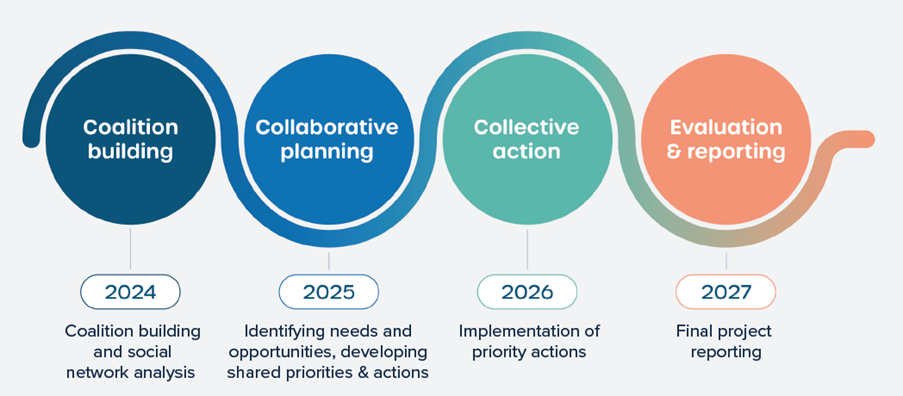
Figure 1: Project Phases. The image depicts the four phases of the project, which each phase articulated in a circle. A line curves around the top and bottom of each circle to show how each project phase leads to the next. The first circle is dark blue and says ‘Coalition building’; the second is a lighter blue and says ‘Collaborative planning’; the third is a light green and says ‘Collective action’ and the fourth is a light orange and says ‘Evaluation and reporting’. A timeline underneath the circles indicates the first phase (Coalition building and social network analysis) started in 2024, the second phase (Identifying needs and opportunities, developing shared priorities and actions) happened in 2025, the third phase (Implementation of priority actions) will happen across 2026 and the final and fourth phase (Evaluation and reporting) will take place in 2027.
Local community service organisations came together in October 2024 to build a shared understanding of diverse organisational roles and opportunities to act on climate change and disaster impacts.
The workshop focused on strengthening climate literacy in a way that centred equity and justice. It explored the potential impacts of disasters on the local community and service delivery infrastructure of participating organisations. It also identified early opportunities to strengthen local climate change and disaster resilience.
A localised scenario exercise was specifically developed for this workshop to guide the impact mapping and response activities.
The findings from this day informed much of our later work – including group model-building workshops in May 2025, an Action Forum in September 2025 and the development of this Collaborative Action Plan.
Social Network Analysis (SNA) is a systems mapping approach. We used it to provide us with an understanding of how organisations in Campaspe Shire work together, where relationships are strong and where there is an opportunity for us to strengthen our ties.
The SNA was informed by both online survey and interview responses. It explored and mapped existing inter-organisational relationships across the community services sector. It also identified challenges and barriers to collaboration in disaster resilience and climate adaptation. This SNA will be repeated in 2027; we will be interested to see where there are similarities and differences.
Community service organisations are generally very well connected within Campaspe, but would like stronger engagement with Aboriginal Community Controlled Organisations and with emergency services. Local government was frequently cited as a critical source of information, guidance and support. The vital role played by Neighbourhood and Community Houses in disaster recovery and ongoing community support was also frequently acknowledged. They have strong relationships and a deep understanding of the community’s needs.
While some relationships were categorised as strong, collaborative and relatively easy to maintain, others were described as requiring ongoing effort, adaptation, and strategic engagement to remain effective.
Here are some frequently identified challenges and opportunities.
Challenges
Opportunities
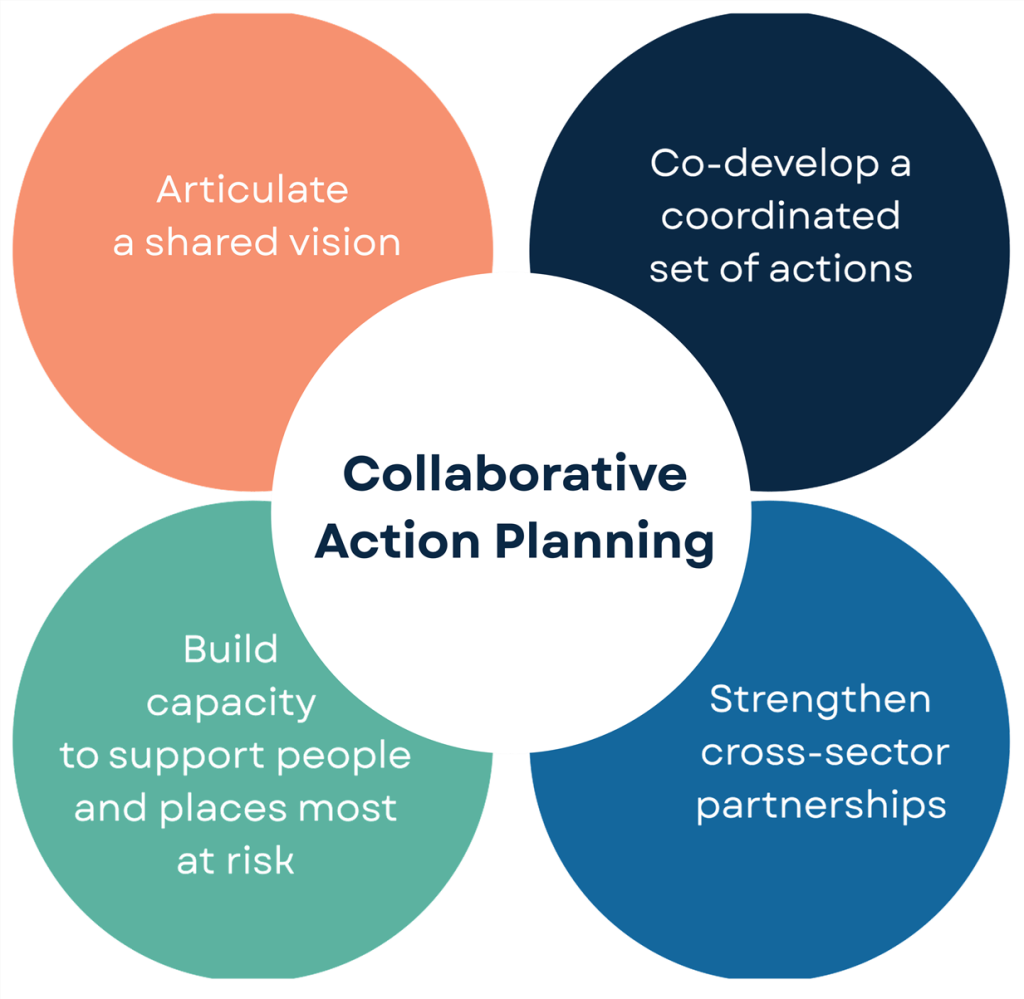
The Collaborative Action Planning process has required a significant time investment from all the organisations participating in this project. We believe that the process has very real benefits – for organisations and the communities we serve.
In 2025 we held Group Model Building workshops and an Action Forum as part of the Collaborative Action Planning Process.
Collaborative Action Planning enables us to understand and improve how our system responds to climate-related disasters. It provides organisations with the opportunity to build a shared understanding. It also makes the plans more practical and realistic. Organisations are more likely to act on plans they have made together.
Throughout the process, collaborative action planning also builds trust and connections between organisations, which makes the service systems stronger and more resilient.
By working together, local organisations have identified shared goals, actions and strategies to address the unique challenges faced by their communities.
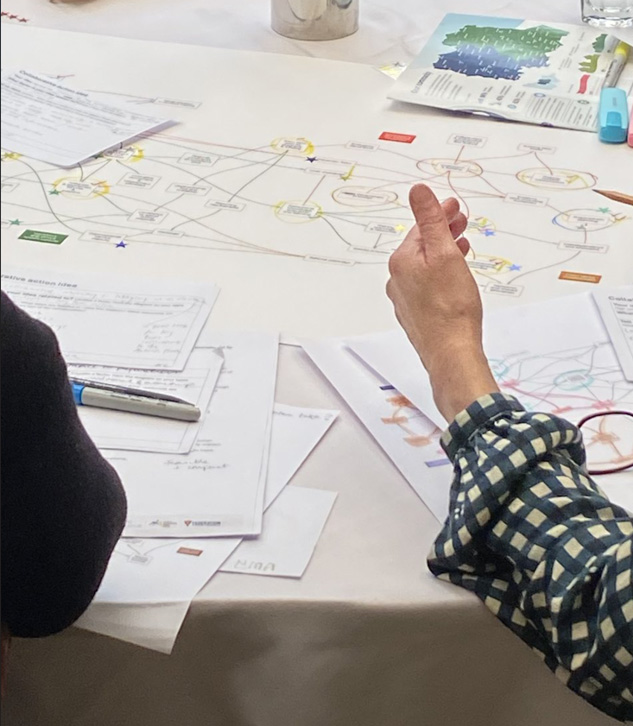
We used Group Model Building (GMB) to explore in depth the systemic drivers of organisation vulnerability to climate change and related disasters. GMB is a participatory approach to engaging with complex systemic issues and has been applied in chronic disease prevention and other areas of health and wellbeing. It is an effective tool when working with multiple organisations who may have different agendas, views on what the ‘problem’ is defined to be, as well as potential interventions.
The question posed was: ‘what factors influence the ability of the Campaspe Shire service system to meet community needs in the face of climate change and climate-related disasters?’
Across two workshops, participants explored the different factors that impact on the service system’s strength and resilience and how those factors relate to each other. We used that information to develop a system map / causal loop diagram.
The Action Forum in September 2025 brought together leaders and organisational champions of this work. The aim was to identify collaborative action ideas that participants believe will strengthen the service system.
They used the system map developed from the GMB process as a starting point to develop collaborative action ideas. Beginning by exploring that diagram, participants reflected on the factors that resonated most strongly with them in their own work. Still using the diagram, they were asked to think about leverage points in the system and identify where action was already taking place, where they believed it was important to act and where they thought organisations had the most power to act.
The next activity had participants brainstorming action ideas, in answer to this guiding question developed by the Regional Advisory Group:
“What collaborative actions can we take to strengthen the service system in Campaspe Shire to better meet the needs of all the community in the context of a changing climate and increasing climate-related disasters?”
These ideas were shared and then prioritised. Participants indicated which ideas they believed their organisation would be able to support.
It was here that we moved from the shared understanding developed in earlier project work to a shared commitment to act. It is these ideas that form the basis of this plan.
The forum also provided an opportunity for participants to meet and share with people they don’t usually work with – strengthening relationships.