
Our changing climate has a direct impact on the communities we serve. This project has built on our experience working after the 2022 floods in Campaspe. From this work we know that disasters have long-lasting and complex outcomes.
Climate change impacts are felt inequitably across our community and that is a justice issue. Communities, groups and individuals with resources and access to appropriate and timely support fare significantly better when disasters hit. This is an issue of justice that requires transformative, systemic change.
Climate change impacts directly on community service organisations themselves. Community service organisations in Campaspe have an important role to play in supporting communities and in taking a justice approach to climate action. At the same time, those organisations themselves are vulnerable to the risks.
These three key reasons provide the impetus and urgency for the collaborative work described in this plan. Strengthening the Campaspe service system through collaborative action is an essential response.
The Australian Government, through the Australian Climate Service, notes that most scientists agree that “climate change is adding to Australia’s natural climate variability, driving changes in average and extreme weather.”
We know that the climate is changing locally. The Australian Climate Service identifies eight weather-driven natural hazards, including extreme heat, floods, bush and grass fires, storms and drought, that are of particular concern to us in Campaspe. After extreme heat, flooding is the second deadliest natural hazard – being responsible for one-in-five disaster related deaths (Australian Climate Service).
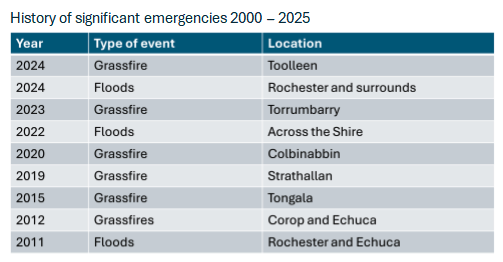
Campaspe Shire has a history of emergencies related to riverine flooding and grassfires. The Council’s Municipal Emergency Management Plan records the events of significance:
Projections from the Victorian Government and CSIRO suggest that by the 2050s Loddon Campaspe can expect:
The detrimental impact of climate change on health and wellbeing is recognised both globally and locally. The World Health Organization says:
“Climate change presents a fundamental threat to human health. It affects the physical environment as well as all aspects of both natural and human systems… it is therefore a threat multiplier”
Community service and health organisations in Campaspe also recognise this risk. Campaspe Shire Council’s Council and Wellbeing Plan 2025-2029 includes tackling climate change as a priority:
“Climate change threatens health, wellbeing and safety through extreme weather events like heatwaves, storms, floods and bushfires. Campaspe residents and businesses have been significantly impacted by the 2022 floods. These impacts can include negative mental health outcomes. Prevention and early intervention supports are critical for flood-affected communities, to heal and recover” -affected communities, to heal and recover”
Climate change is not only a threat to health and wellbeing – it is also a social justice issue.
“Climate justice recognises the connection between social justice and climate change. It focuses on how the most marginalised communities are being disproportionately affected by climate change. Responses to climate change must be driven by equitable, fair and inclusive interventions. And those in power need to address existing systemic issues and drivers that create and perpetuate inequity and environmental harm.” FCLC The Climate Justice Field Guide p.16
There are particular demographic characteristics in the Campaspe population that we know increase risk and may restrict people’s adaptative capacity in the face of a changing climate. In Campaspe the population:
(Australian Bureau of Statistics 2021 Census Data – All Persons QuickStats)
Natural hazards don’t automatically become disasters. Many experts, including the United Nations Office for Disaster Risk Reduction, argue that while hazards may be natural, disasters are not. Disasters happen when people and assets are exposed to hazards and their impact is greater than we can avoid, manage or recover from.
Importantly, these are factors that we can influence through collective advocacy and action.
The VCOSS report A Strong Community Sector for a Safe Climate lists multiple likely impacts of climate change on Victorian community service organisations, including:
During and after an event, community need will increase at the very time community service organisational capacity to respond decreases. VCOSS characterise this as a crisis (VCOSS 2024, p.6).
Community service organisations each have their own strategic objectives and priority communities that will guide the collaborative activities they participate in.
For a comprehensive look at Campaspe Shire’s demographic and health data see the Loddon Mallee Public Health Unit’s Community Data Profiles.
Here are a series of resources that explain the Climate Impacts on Social Injustices.
Read What Climate Justice Means to Us for a comprehensive and challenging view from the Lived Experience Advisory Group who informed the development of the Climate Justice and Resilience Toolkit.
Women’s Health Loddon Malle resource Applying a Gender Lens to Smoke and Heat has a range of evidence about the differential impacts climate risks have on women, men and gender diverse people.
Gender and Disaster Australia have a number of general resources and these roadmaps that include information about gendered expectations, responses and domestic violence.